
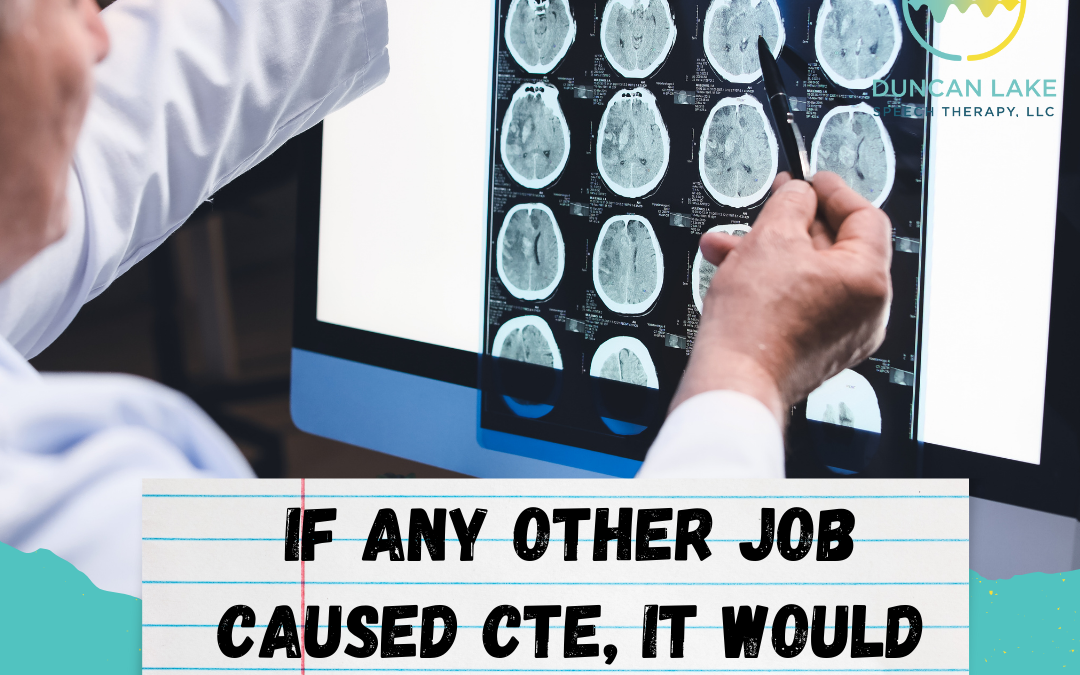
An opinion piece of sorts.
by Tamiko Teshima, M.A., CCC-SLP
Practice Owner & Speech-Language Pathologist
Duncan Lake Speech Therapy
We accept a level of brain injury in professional football that would be completely unacceptable in any other profession.
That sentence is uncomfortable. It should be. Let’s get into it!
Chronic Traumatic Encephalopathy, or CTE, is a progressive, degenerative brain disease linked to repeated head impacts. This is not just caused by diagnosed concussions, but routine, expected blows to the head that occur during normal play. Symptoms often appear years or decades after exposure and can include memory loss, emotional dysregulation, impulsivity, depression, aggression, and dementia. There is no cure.
CTE became widely known through the work of Bennet Omalu, who identified the disease in former professional football players and faced significant resistance when his findings challenged the safety narrative surrounding the NFL.
Research has increasingly shown that concussions are not isolated events, but true brain injuries with cumulative effects over time. Repeated concussions and even sub-concussive impacts are associated with long-term changes in brain structure and function. We explored this connection in more depth in a previous research review on the relationship between concussion, brain injury, and CTE, highlighting why these injuries cannot be dismissed as temporary or benign.
Once you remove the helmets, the fandom, and the highlight reels, the question becomes very simple.
What would happen if any other job carried the same risk profile?
How occupational safety usually works
In most professions, there are clear thresholds for intervention. If a job is shown to:
- Cause cumulative brain injury
- Lead to permanent neurological impairment
- Produce symptoms years after employment ends
- Remain dangerous even with protective equipment
Then one of three things typically happen – The hazard is eliminated, the job is radically redesigned, or the profession becomes legally and financially impossible to maintain.
We have seen this pattern before.
Asbestos exposure was once routine. When its connection to mesothelioma and chronic lung disease became undeniable, its use was restricted or banned outright. Coal mining practices changed dramatically once black lung disease was recognized as an occupational consequence, with compensation systems put in place. Even military training protocols have been modified as evidence grows about long-term brain injury from blast exposure.
In these cases, the argument that workers “knew the risks” was not sufficient, especially when those risks were minimized, misunderstood, or actively denied.

Why football is treated differently
Professional football is an outlier, not because it is safer, but because it is culturally protected. Several factors allow this level of harm to persist.
- First, football is classified as entertainment rather than a traditional workplace. This places it outside many standard occupational safety frameworks.
- Second, there is a strong consent narrative. Players are framed as willingly accepting the risks, even though for decades those risks were downplayed or denied.
- Third, the most devastating consequences often occur long after a player’s career ends. This delay relaxes accountability and weakens public urgency.
- Finally, football is emotionally and economically powerful. It generates enormous revenue and cultural identity, which makes meaningful reform politically and socially difficult.
Importantly, this is not just a historical issue. Recent reporting from The Athletic and The New York Times highlighted that even recent rule changes intended to reduce concussions have had unintended consequences. Adjustments to kickoff rules, designed to limit high-speed collisions, were followed by an increase in concussion rates on returns, prompting renewed concern and review by league officials. These real-time developments underscore how difficult it is to meaningfully reduce brain injury risk in a collision sport, even with active safety interventions.
None of these factors reduce the harm. They simply make it easier to tolerate.
If this was any other profession….
Imagine if teachers, factory workers, healthcare providers, or delivery drivers faced a significant risk of developing a fatal neurodegenerative disease simply by doing their jobs as intended. That profession would not survive unchanged.
Insurance coverage would collapse. Workers’ compensation systems would be overwhelmed. Employers would face negligence claims. Regulators would intervene. Training standards, job duties, or the profession itself would fundamentally change. We would not debate whether the job was “worth it.” We would debate how quickly we could prevent further harm.
So, the question isn’t about whether football should exist. It is a question about why we accept levels of brain injury in athletes that we would never accept anywhere else, especially when children and adolescents are involved. History shows that industries built on slow, invisible harm eventually face a reckoning. Delay does not mean the harm is acceptable. It only means it has been normalized. CTE forces us to confront an uncomfortable truth.
If this were any other job, we would have shut it down or rebuilt it already.
Recent Comments